
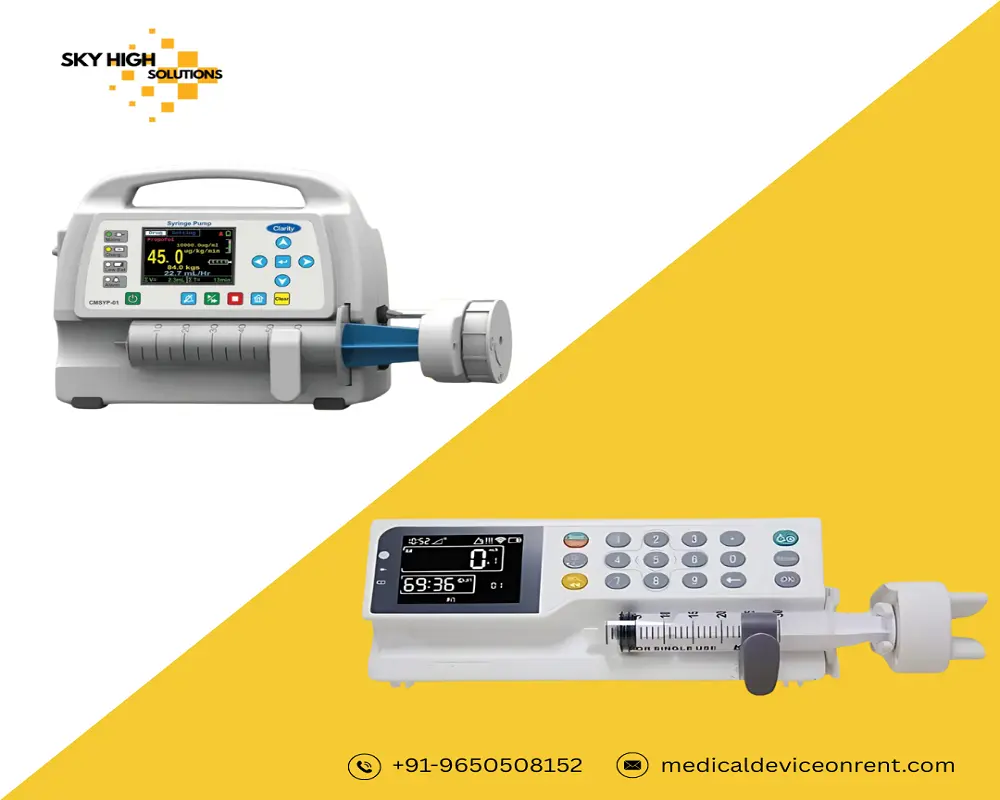
Syringe pump vs infusion pump is a common comparison in modern healthcare, where accurate and controlled medication delivery is critical for patient safety and recovery. Two commonly used devices for this purpose are syringe pumps and infusion pumps. While both are designed to deliver fluids and medications at controlled rates, their working mechanisms, use cases, and applications are different. If you are a caregiver, healthcare professional, or someone arranging medical equipment for home care in India, understanding the difference between a syringe pump and an infusion pump can help you make the right decision.
This detailed guide explains syringe pump vs infusion pump, their features, differences, advantages, and when to choose each — especially for hospital and home care use in India.
What Is a Syringe Pump?
A syringe pump is a medical device designed to deliver small and highly precise volumes of medication or fluids over a specific period. It uses a standard medical syringe mounted on the pump, which pushes the plunger at a controlled speed.
Syringe pumps are commonly used in critical care units, neonatal ICUs, anesthesia departments, and during procedures that require extremely accurate dosing.
Common Uses of Syringe Pumps
- Delivery of potent drugs such as insulin, sedatives, or pain medication
- Neonatal and pediatric care where dosage accuracy is crucial
- ICU and anesthesia applications
- Chemotherapy and research settings
Key Features of Syringe Pumps
- High precision for low-volume drug delivery
- Compatible with different syringe sizes
- Programmable flow rates
- Compact and easy to transport
What Is an Infusion Pump?
An infusion pump is a medical device used to deliver larger volumes of fluids or medications into a patient’s body over a controlled time. Instead of a syringe, it typically uses IV bags or bottles.
Infusion pumps are widely used in hospitals, clinics, and increasingly for home care in India, especially for long-term treatments.
Common Uses of Infusion Pumps
- IV fluids and hydration therapy
- Antibiotics and nutritional support
- Pain management and post-surgical care
- Long-duration medication delivery
Key Features of Infusion Pumps
- Suitable for continuous fluid administration
- Supports gravity-based or electronic flow control
- Can deliver higher volumes over longer periods
- Ideal for long-term and general patient care
Syringe Pump vs Infusion Pump: Key Differences
Understanding the core differences between these two devices helps in choosing the right equipment.
| Feature | Syringe Pump | Infusion Pump |
|---|---|---|
| Fluid Volume | Small volumes | Medium to large volumes |
| Accuracy | Extremely high | Moderate to high |
| Delivery Method | Uses a syringe | Uses IV bag or bottle |
| Best For | Critical care, pediatrics | Long-term fluid therapy |
| Common Setting | ICU, OT, NICU | Hospitals, home care |
| Duration | Short to medium | Medium to long |
When Should You Use a Syringe Pump?
A syringe pump is ideal when precision matters more than volume. In Indian healthcare settings, it is frequently used for:
- Neonates and infants
- Patients requiring controlled micro-doses
- Administration of high-risk medications
- ICU patients under close monitoring
If the medication dosage must be delivered at an exact rate without fluctuation, a syringe pump is the safest choice.
When Should You Use an Infusion Pump?
An infusion pump is better suited for continuous or long-duration therapy, especially when larger volumes are required.
It is commonly recommended for:
- IV fluids and electrolyte management
- Antibiotic therapy
- Nutritional and hydration support
- Home care patients requiring extended treatment
Infusion pumps are often preferred for home healthcare in India because they are easier to manage for longer treatments.
Syringe Pump vs Infusion Pump for Home Care in India
With the rise of home healthcare services across India, choosing the right pump has become increasingly important.
Syringe Pump for Home Use
- Suitable for short-term, precise drug delivery
- Requires trained handling and supervision
- Common in pediatric or critical home care cases
Infusion Pump for Home Use
- Ideal for continuous IV therapy
- Easier for caregivers to manage
- More commonly rented for home use
For most home care needs, infusion pumps are preferred, while syringe pumps are used only when medically required.
Accuracy and Safety Comparison
Safety is a top priority in medical equipment selection.
-
Syringe pumps provide superior accuracy, making them suitable for sensitive medications.
-
Infusion pumps include alarms for flow interruption, air detection, and power failure, ensuring patient safety during long treatments.
Both devices, when used correctly, are safe and reliable.
Cost Considerations in India
The cost of purchasing medical pumps can be high, especially for short-term needs. This is why many patients and hospitals in India prefer renting medical equipment.
Why Renting Is a Better Option
- Lower upfront cost
- Maintenance and servicing included
- Flexible rental duration
- Ideal for temporary medical needs
Renting a syringe pump or infusion pump allows patients to receive high-quality care without financial burden.
How to Choose the Right Pump?
Ask yourself the following questions:
- Does the patient need precise micro-dosing or continuous fluid delivery?
- Is the treatment short-term or long-term?
- Will the device be used in a hospital or at home?
- Is professional supervision available?
Answering these will help determine whether a syringe pump or infusion pump is the right choice.
Syringe Pump vs Infusion Pump: Quick Summary
- Choose a syringe pump for precise, low-volume medication delivery.
- Choose an infusion pump for long-duration or high-volume fluid administration.
- For home care in India, infusion pumps are generally more practical.
- Renting is cost-effective and convenient for both devices.
FAQs
1. What is the main difference between a syringe pump and an infusion pump?
A syringe pump delivers small, highly accurate doses using a syringe, while an infusion pump delivers larger volumes of fluids from IV bags over time.
2. Can syringe pumps be used at home?
Yes, but only when medically required and with trained supervision.
3. Which pump is better for long-term use?
Infusion pumps are better suited for long-term and continuous therapy.
4. Are these pumps safe for elderly patients?
Yes, both are safe when used correctly and monitored properly.
5. Is renting medical pumps common in India?
Yes, renting medical equipment is increasingly popular due to affordability and convenience.
Rent Syringe Pump or Infusion Pump in India
If you are looking for a syringe pump or infusion pump on rent in India, Medical Device on Rent offers reliable, well-maintained equipment suitable for hospital and home care use. We provide doorstep delivery, professional support, and flexible rental plans to meet your medical needs.
Visit Medical Device on Rent to explore high-quality medical equipment rentals designed for patient comfort, safety, and care.
Conclusion
Syringe pump vs infusion pump selection depends on dosage accuracy, treatment duration, and the care setting. Syringe pumps are ideal for precise, low-volume medication delivery, while infusion pumps are better suited for continuous and long-term therapy. For hospital or home care in India, choosing or renting the right device ensures patient safety, convenience, and cost-effective treatment.